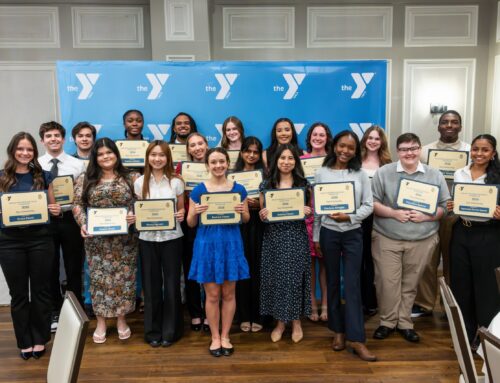
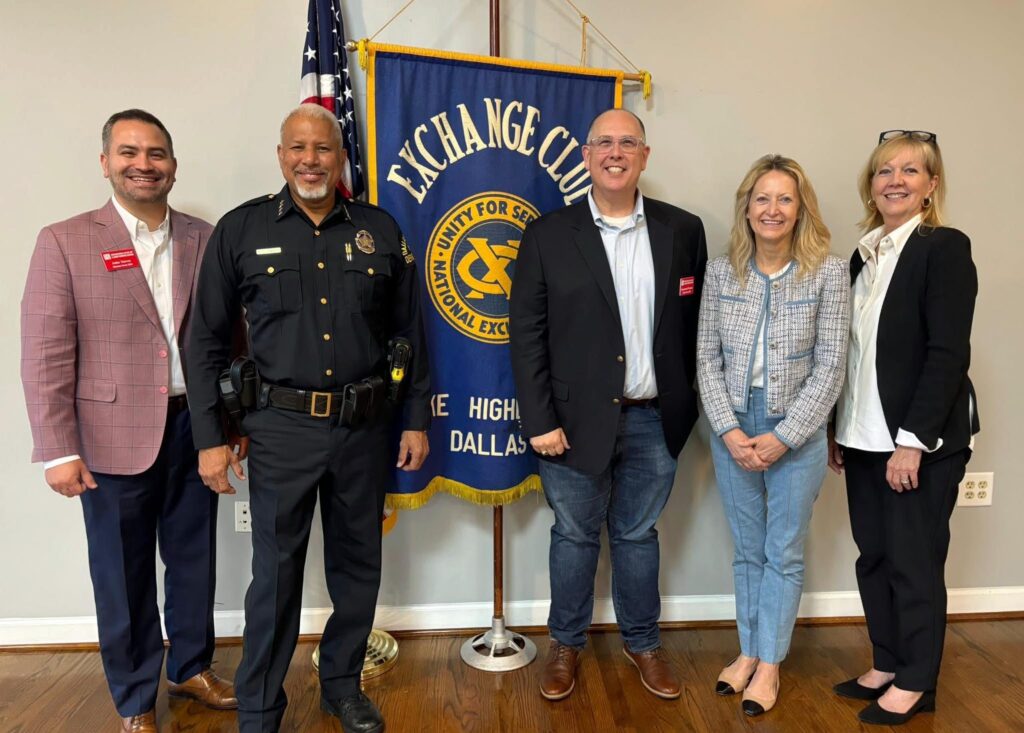
John Torres, Chief Daniel Comeaux, Raymond Fisher, Lynn McBee and Kathy Stewart
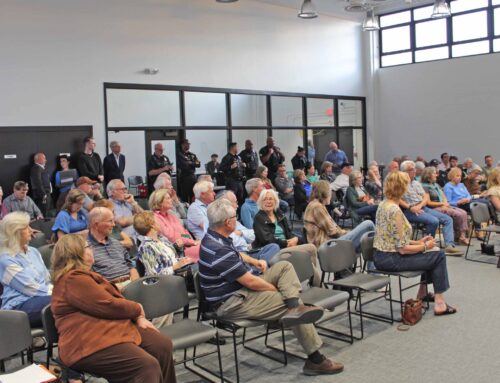
Dallas Police Chief Daniel Comeaux was charming and affable as he visited with members of the Exchange Club of Lake Highlands at their regular Friday morning meeting last week. He spoke on topics as wide-ranging as how to fill Dallas’ desperate need for more officers, how to stem the tide of teen fentanyl overdose deaths and where to find a good po’ boy in his native New Orleans.
Comeaux didn’t start out to become a law enforcement officer, much less a police chief. In fact, he admitted he was more likely to run from the cops as a teen than to become one.
“I was playing baseball at Southwest Texas State (now Texas State University), and I got hurt,” he explained. “I was the guy that always figured I was going to play in the majors. I never really had any other plans until I tore my shoulder and needed reconstructive surgery.”
Gary Herman, one of Comeaux’s teammates, had a father who faithfully attended the boys’ games. After the injury, Police Sergeant Herman approached him with an observation — and a proposal.
“I know you’re down and sad,” Herman said, “but I think you have the personality to be a police officer.”
“Me? I ran from you guys,” Comeaux laughed in response. “But I did watch Barnaby Jones, CHiPS and Baretta every time they came on TV.”
Herman greased the skids, and Comeaux was quickly accepted into the Houston Police Academy. A year later he was working to arrest a crowd of unruly people fighting on a street corner. Shots were fired amid the chaos, but he noticed an elderly woman sitting on her porch, trying to get his attention.
“I went over and she looked at me, and she just said, ‘thank you very much. I truly appreciate it. All I want to do is sit on my porch.’ It stuck with me, and I’ve never, ever forgotten that. At that moment, I decided I was going to be the very best officer that could be. I wanted to strive to be the best. I was always competitive, just from being an athlete. That made me just drive and strive to be the very best. And here I am, 35 years later.”
Comeaux said he’s been very intentional about his career moves since then, shifting between stints in local and federal law enforcement. While working with the Drug Enforcement Agency, he led major operations to reduce violent crime and drug trafficking in Houston, San Francisco and Los Angeles. As special-agent-in-charge over the Houston office, he commanded twelve offices across Texas, including 645 miles of the U.S.-Mexico border. He saw a 40% decrease in overdose deaths in hard-hit Laredo.
“I’ll tell you how the reduction in overdose deaths happened. It happened from mornings like this,” Comeaux said, indicating the impact of communicating the risks of Fentanyl with parents and neighborhood leaders. “What we do extremely well in the DEA is put people in jail, and we were putting all these dope dealers in jail, but we weren’t seeing a reduction. We were seizing all these drugs, but the overdoses weren’t going down. When we really started working on the education and awareness piece of it, that’s when the deaths started going down. Laredo teamed up with us at community meetings like this, and we got out and started telling people what to look for.”
Comeaux said he has similar creative plans to make the streets of Dallas safer, and he’s already had some success in his first six weeks on the job. One of his first initiatives was a plan to get known felons off the street. He gathered manpower to arrest criminals with felony warrants — people who have committed numerous, often violent, crimes.
“We arrested 98 people in 30 days who were responsible for 700 prior arrests,” Comeaux said. “They don’t need to be on the street.”
Comeaux was swept up in a tempest, though, when he was quoted by a television reporter as saying some folks should “pick another city,” “don’t come to Dallas” because “you’re not welcome” here. The station’s editing and discussion seemed to indicate the chief was speaking directly to immigrants. Comeaux said he was instead answering a question about gang members and violent criminals.
Regarding immigration enforcement, Comeaux said his position is simple: officers under his command will follow the law.
“Obviously this has been a sensitive subject in a lot of areas,” he said. “We’re going to obey and abide by the law. The city of Dallas is very clear, you must assist and cooperate with state and federal officials. It’s very clear, and we’re going to do that. As long as everything is being done legally, we’re going to do our part. Now, what’s our part? I don’t know, because no one has asked me since I’ve been chief to assist or cooperate in any targeted investigations.”
Another new initiative already making a difference began with a community meeting of downtown residents. One attendee mentioned that he’d never seen anyone get a traffic ticket downtown.
“As I was walking to the car, right on cue, the (traffic) light turns red,” Comeaux said. “I’m always looking down at my phone and, whoosh, I almost got hit.”
The chief initiated action with his folks in the motor vehicles and traffic unit, and in one week’s time they’d written a thousand tickets. Turns out every time the light changed, three or four cars ran the light.
“Some of the council members have been providing me with intersections they feel are dangerous in the areas they live in. Now the thing is, everybody wants traffic enforcement until they get traffic enforcement,” he laughed.
The chief explained that ticket writing has lessened across the city over the past few years because Dallas currently has a significant shortage of officers. After a previous high of about 4,000, the ranks are down to about 3,200.
“We’re really doing more of a targeted approach on recruiting, and I’m very confident it’s going to work. One of the things that I will not do — and I’ve talked to the recruiting team — we’re not going to lower the standards for officers, because if we lower the standards then we bring in the wrong ones. It not only makes the department look bad — it makes the city look bad.”
Comeaux said his team recently sought Houston recruits via a social media campaign of Houston vs. Dallas smack talk which caught the attention of TV and radio stations there. The media outlets broadcast stories about the feud, including dates of DPD’s interview sessions. The slots filled quickly, and new recruits were hired.
World Cup in 2026 will be a particular challenge for law enforcement, with millions of international visitors expected.
“The main thing is to keep everybody safe and capitalize on the money that’s coming into Dallas,” Comeaux said. “We’re going to have officers working around the clock — working way more hours than normal. My coming from the federal side will be helpful, because when you have big crowds like that, we’ll work shoulder to shoulder with the FBI to make sure no one’s coming into Dallas trying to create harm.”
Comeaux said he’d like to put some tools in place before the games, including additional use of something Dallas already does well — Flock Cameras. Flock Cameras capture images of vehicle license plates, then match that data against vehicles of interest, such as stolen cars or those associated with known crimes or criminals.
Comeaux said he’s also met with the folks at Project Safe Neighborhood, a program which fosters collaboration between the DPD, ATF, FBI, DEA, Homeland Security and other local, state and federal law enforcement agencies. The groups focus on crime data, then target areas where offenses spike or persist. Hardened criminals who receive sentences of one or two years for their first one or two crimes in the state system can get life in prison when federally processed as repeat offenders.
“Some people deserve life in prison,” he said. “If they don’t, they just keep committing felonies.”
Comeaux has moved around a bit as he’s taken various jobs, and he’s “very happy” to be settling down now in Dallas. He and his wife are both foodies, and they’ve embraced the food palate of each new place they’ve landed.
“I do all the cooking in my house, so when I get home and take off this gun belt, the first thing my wife says is, ‘honey, what are we eating tonight?’”
In Los Angeles, they enjoyed the ambiance of all the beautiful new restaurants. In Arizona, they loved the authentic Mexican food — especially the fresh tableside guacamole. In San Francisco they craved the chowder, and in Houston they ate lots of delicious barbecue.
“Look, I’m in Dallas now. Even if I think the Houston barbecue is better, I’m going to say it’s better in Dallas. Houston will not beat us. Not now.”
In his native New Orleans, it’s all about the boiled crawfish and etouffee. His favorite is Lil’ Dizzy’s, a small cafe on Esplanade Avenue. For po’ boys, he recommends Mr. Ed’s Oyster Bar and Fish House. After hours, he stops in at a joint called We Never Close.
Oh, and one more thing. If you run into Chief Comeaux this summer and you’re tempted to tell him all about your summer vacation, just don’t. When City Manager Kim Bizor Tolbert hired him in April, she said she needed him to start work quickly. He’d have to skip that European vacation planned with his wife and 30 friends to celebrate his own birthday. He didn’t mind (much) since he was happy to get the job, and the friends took him with them (sort of). Everywhere they went, from Italy to the Greek Isles, they held up the chief’s photo — Flat Stanley style.
Happy birthday and welcome to Dallas, Chief.
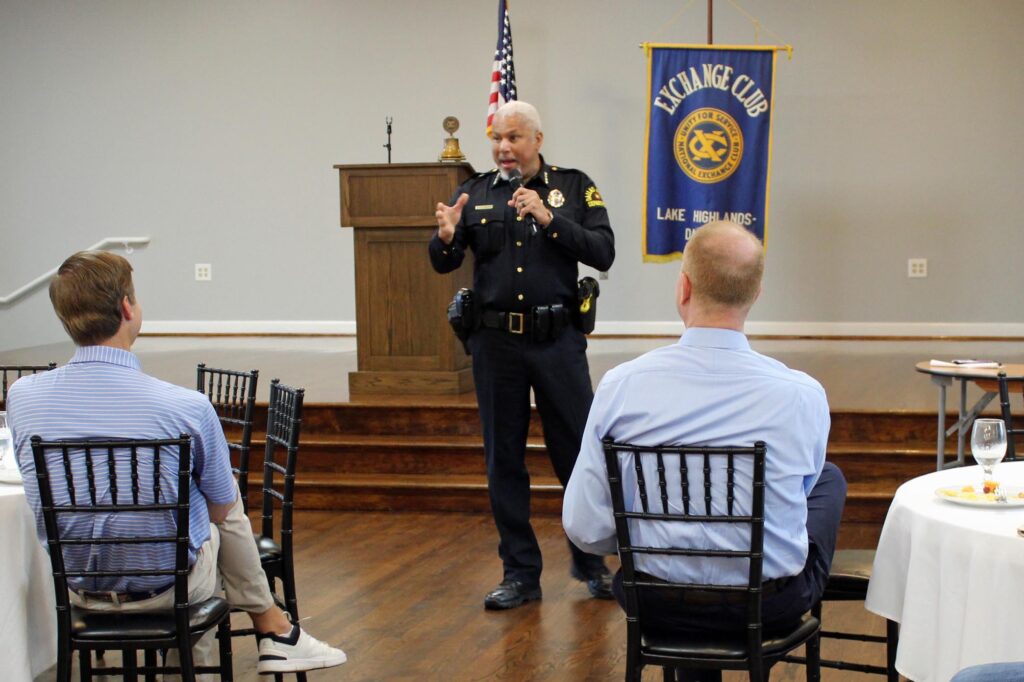
Chief Comeaux speaks to Exchange Club members