Dallas Animal Services is hosting a coyote education meeting at Lake Highlands North Recreation Center this week.
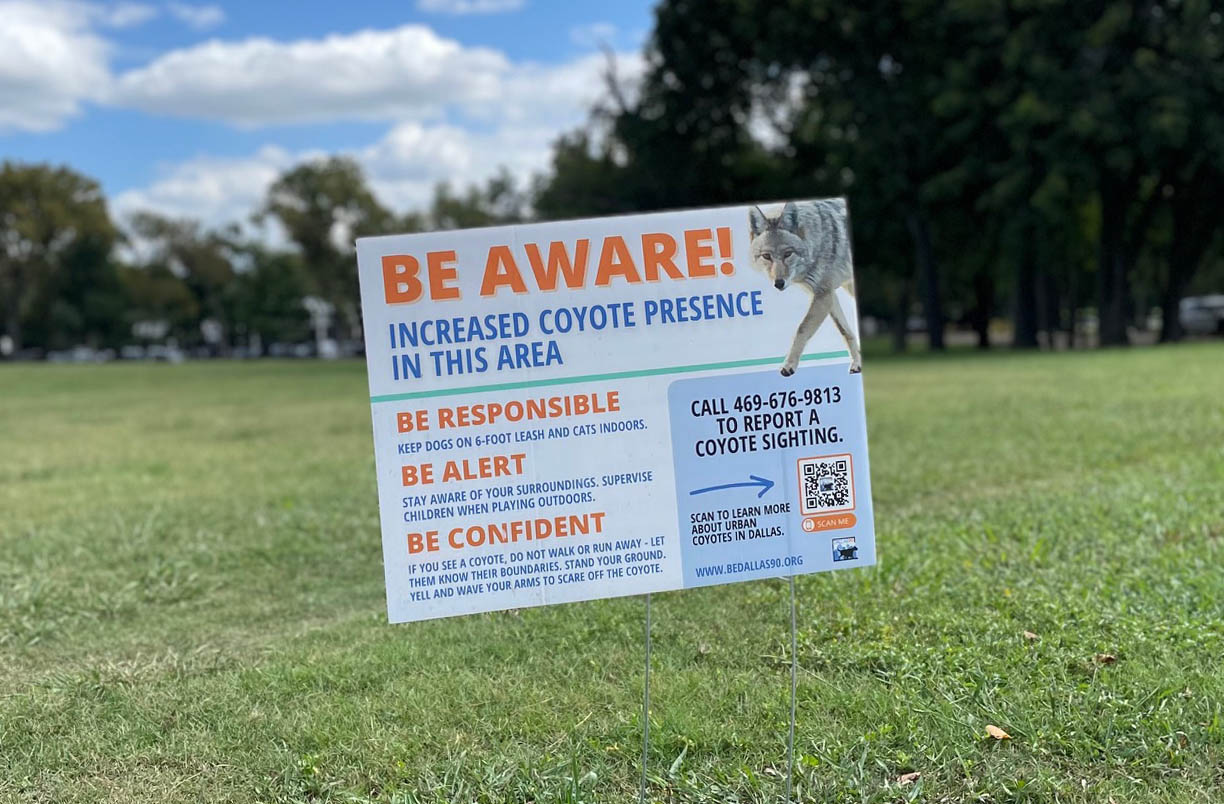
Sign near Flag Pole Hill warns visitors to be aware of increased coyote presence in the area. Photo by Carol Toler.
From 6-7 p.m on Thursday, Oct. 9, DAS staff will provide information on coyote behavior and resident safety measures to District 10 neighbors at Lake Highlands North Recreation Center. On-site DAS staff will provide information on coexisting with urban coyotes and steps neighbors can take to protect themselves, their families and pets.
The news comes as coyote activity — especially around White Rock Lake — has become a notable concern for Dallasites in recent years as urban development pushes wildlife further and further into residential areas. In the spring, DAS staff hosted a similar meeting at the Bath House Cultural Center in response to increased coyote activity in the area. The meeting was held only a few weeks after it was reported that two children had been chased by a coyote near the southern end of White Rock Lake.
View this post on Instagram
Recently, our own Carol Toler reported on an uptick of coyote and bobcat sightings in Lake Highlands and the White Rock Lake area seen in September. In the article, neighbors expressed concerns over coyote encounters and attacks on pets and other area wildlife, including the peacocks that roam near White Rock Stables.
In August, White Rock Stables staff told the Advocate 24 peachicks had been born on the property last Spring, but that only six remained alive at the time of the interview, with coyotes listed among the reasons for the flock’s thinning.
Lake Highlands neighbors are certainly no strangers to the growing familiarity between coyotes and humans. In 2022, a two-year-old was attacked on his front porch by a coyote. While the child survived after being transported to the hospital with critical injuries and lacerations to the face, the incident sparked outrage among neighbors, especially after city officials suggested the incident was the result of neighbors “routinely handfeeding and petting it.”
The incident led City and State officials to ramp up education efforts in the area, with Dallas Animal Services implementing a new coyote management program. As part of the plan, the City now provides an interactive map of coyote sightings that can be found here.
According to DAS’s guide to living with coyotes, while the animals are solitary creatures, they have the ability to adapt to new environments in response to ecological pressures. In these situations, coyotes can venture into new environments such as back yards and neighborhood streets. The animals are mostly seen during the spring pupping season, although they remain active throughout the year.
When a coyote is sighted in a neighborhood or on neighbor property, DAS encourages residents to yell, wave their arms and throw things near (not at) the animal to ward it off. To keep pets safe, the department recommends keeping cats secure and ensuring that dogs left outside are kept within a coyote-proof (at least 8 feet tall and made of material the animals can’t climb) fence.
DAS stresses that socialization (i.e, getting too comfortable with humans) can lead to coyote incidents in residential areas. To avoid this, neighbors are strongly encouraged to refrain from feeding the animals.
If neighbors come across a coyote that appears sickly, socialized or rabid, they are asked to get away from the animal and call 911. In cases where the encounter is not a pressing danger, neighbors can report the sighting to the City’s coyote hotline at 469-676-9813.