
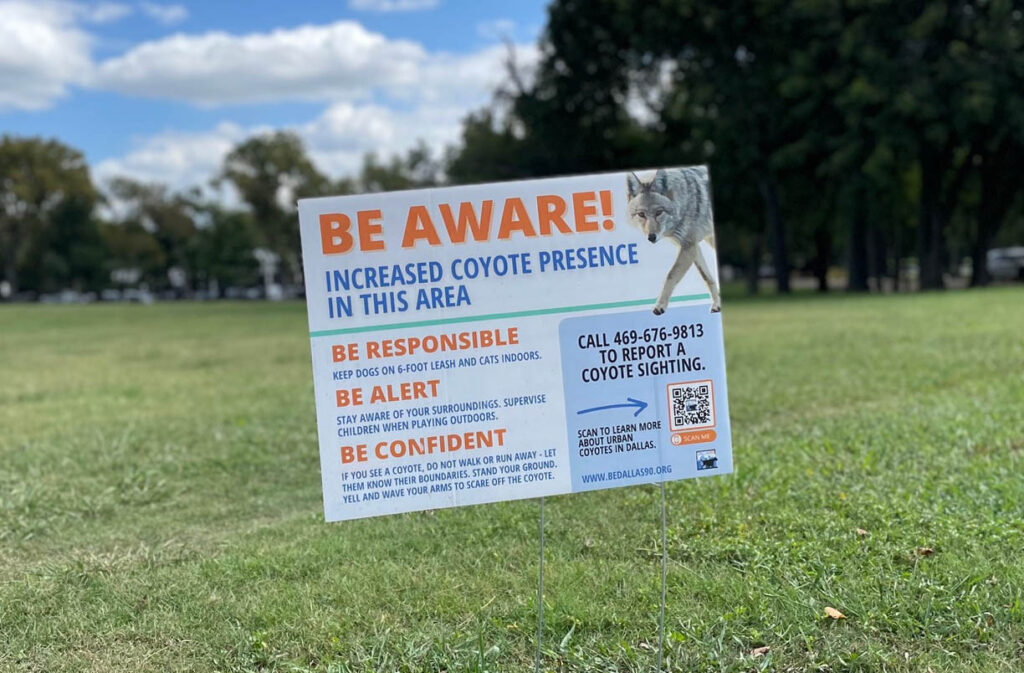
Sign near Flag Pole Hill warns visitors to be aware of increased coyote presence in the area. Photo by Carol Toler.
It was well before 7 a.m. last Sunday morning when Phillip Cannatti first spotted the lone coyote near the pickleball courts at the Lake Highlands North Recreation Center. He was walking his dogs as usual across from Lake Highlands High School and Wildcat Stadium when the animal approached.
“This coyote was not deterred by our two mid-sized (50 lbs) dogs and continued to follow us at varying distances for a few minutes,” he shared on Nextdoor.com. “Just something to be aware of in case you are out and about in the early morning hours.”
Cannatti and I had spoken about other stories in the past, so we chatted again about this one. I told him I’d received a slew of messages over the past two weeks from folks who’d spotted coyotes and bobcats while walking in the neighborhood — or the detritus of dead animals, clearly killed by coyotes and bobcats. He wasn’t surprised.
“This medium sized coyote looked to weigh about 40 to 50 pounds and ran up on our dogs as we were walking past the tennis/pickleball courts. It wasn’t discouraged by both dogs and/or me making loud noises. It seemed curious but not overtly aggressive, but it did get adjacent to our dog on the initial encounter.”
Colleen Kelly also took to Nextdoor to warn neighbors of a similar encounter — but this coyote seemed more threatening.
“Just an FYI, my husband and dog were chased and attacked by a large coyote about 20 minutes ago at the park across from the high school,” she wrote. “Neither my husband nor my dog are small, so please be aware.”
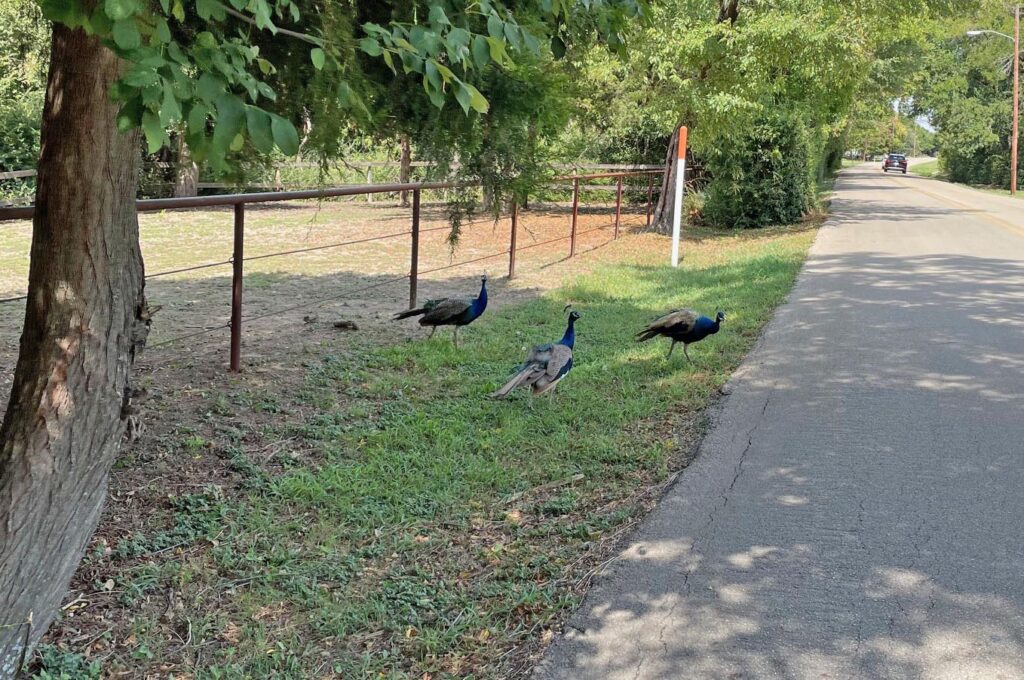
Peacocks freely roam White Rock Valley. These were see near Goforth and Lawther. Photo by Carol Toler.
Pete Townsend lives in White Rock Valley, and he enjoys seeing the peacocks roaming the neighborhood while walking his dog, Lucy. Last Friday, Lucy found “remainder parts” of a peacock, which Pete believes was attacked and eaten by a coyote.
“In the 28 years we’ve lived here, it is the first time Pete has run across that type of peacock carnage,” Pete’s wife, Ellen, told me. “Plus, the bunny population is way down, too. The coyotes are definitely back in the WRE neighborhoods.”
Ellen said she believes the coyote dens may be between Flag Pole Hill and Lake Highlands Presbyterian Church, and she wanted to warn vulnerable people who may walk with young children and small pets.
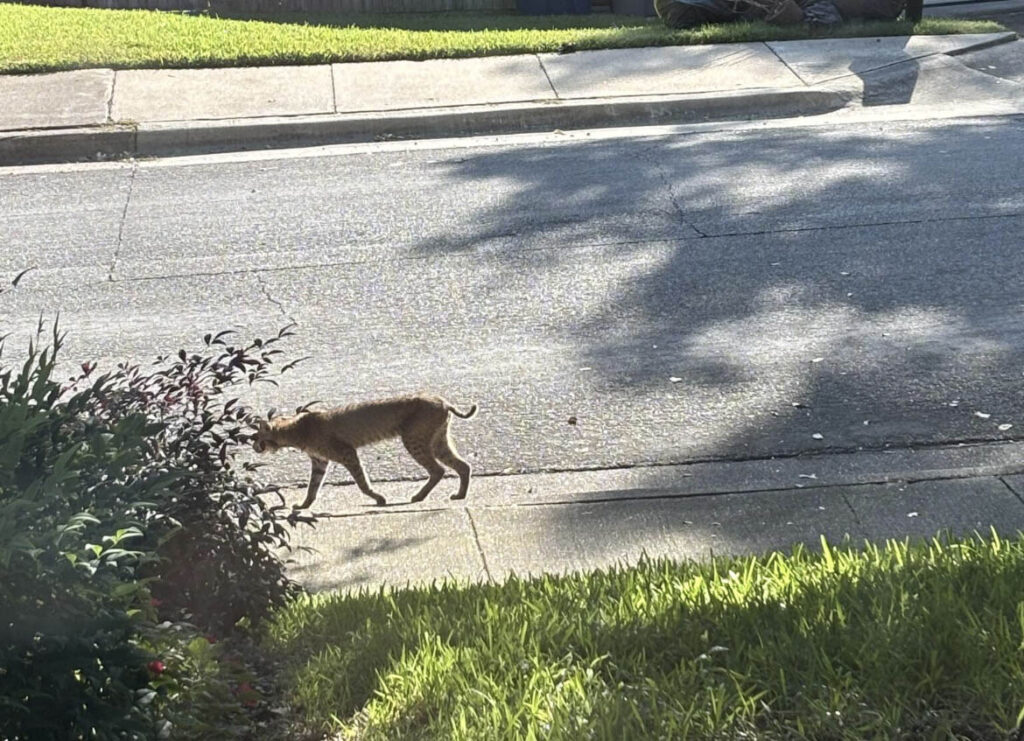
Bobcat photo courtesy of Barbara Hunt-Elkins.
Barbara Hunt-Elkins was safely inside her home on Pleasant View Drive when she encountered a bobcat last Saturday. She was amazed by the animal’s agility and the confident way it walked down her street without fear.
“Warning,” she posted on Nextdoor, “a bobcat just strolled across my deck in my side yard, which is surrounded by an 8-foot wooden fence. He didn’t seem phased by my dog, who was fortunately inside, barking her head off. Photo was taken after he hopped back over my fence and exited across my front yard…”
Officials at the Texas Department of Wildlife say we often see a spike in coyote activity during “pupping season” in the spring, when baby coyotes are born after breeding season in January and February. We are now entering a time when young coyotes become more active as they leave their dens in search of a mate and a territory of their own. These animals are striking out (think teenagers with their first car) and may not exhibit fear of pets or humans, experts say.
Five months ago, a coyote chased two children near White Rock Lake until a parent finally scared the animal away. The children sustained minor injuries.
In 2022, 2-year-old Knox Thomas was grabbed from his front porch in White Rock Valley by a coyote and dragged down his front steps and into his yard before his panicked mother shouted and caused the animal to drop the child and run away. The toddler and his 5-year-old brother, Luke, had been playing with a sand table on the porch while their mom grabbed the last few items on her way out the door. That’s when the animal approached and grabbed the child by the head and neck.
Knox eventually recovered, but the incident caused others in the neighborhood to reveal their own run-ins with coyotes. Four coyotes were removed and tested for rabies. The tests were negative.
At that time, authorities from the City of Dallas and Texas Department of Wildlife stepped up efforts to educate the public by hosting multiple community meetings. City officials created a Coyote Hotline (469-676-9813) and drafted a Coyote Management Plan, with interactive online mapping to receive sighting submissions. They posted information about Living with Coyotes and Hazing Coyotes to their website.
According to Dallas’ Yard Audit Checklist for reducing the danger of coyote encounters, residents should: (1) never hand-feed or intentionally feed a coyote pet food, (2) never feed pets outdoors, (3) always store pet food securely indoors, (4) remove pet water bowls in dry climates, (5) remove bird feeders or clean fallen seed to reduce the presence of small mammals that coyotes prefer to eat, (6) clean up fallen fruit around trees, (7) never include meat or dairy among compost contents, (8) clean up food around barbeque grills after each use, (9) secure all trash containers with locking lids and place curbside the morning of trash pickup, (10) periodically clean cans to reduce residual odors, (11) trim vegetation to reduce hiding places and potential denning sites, (12) restrict access under decks and sheds, around woodpiles or any other structure that can provide cover or denning sites for coyotes or their prey, (13) enclose property with an 8-foot fence to deter coyotes, (14) ensure that there are no gaps and that the bottom of the fence extends underground to deter coyotes from digging underneath, (15) never leave pets unattended outside, (16) never allow pets to “play” with coyotes, (17) fully enclose outdoor pet kennels and (18) walk pets on a leash no longer than 6 feet in length.
Coyotes are reclusive animals who generally prefer to avoid human contact, but if you do encounter a coyote while walking your dog, pushing a stroller or taking your evening constitutional, hazing can be an effective tool for re-establishing the animal’s natural wariness of people, experts say. Hazing utilizes your tools (car keys against the stroller handle, metal water bottles against the sidewalk, etc.), your voice and your body to show coyotes who’s boss. Stand tall, wave your arms and yell until the animal trots away.
If you believe a coyote is sick or injured or is approaching humans or pets, officials advise you to contact 911 immediately and not to interact with or attempt to haze the animal. All other coyote sightings should be reported to the hotline at 469-676-9813.